Tuesday, August 9, 2011

essential training equipment (8): small sticks


The ba gua dao is a weapon unique to ba gua zhang. I translate it rather loosely as “big-ass sword” because it is just pretty dang big. People love old photos of ancient Chinese masters of smaller stature standing next to swords as tall as them.

Think of a normal dao or broadsword. There is only a single blade and it is curved (in contrast to the jian, which is straight and double-bladed). It has a nice, workable length and is used in a large number of Chinese martial arts.

Then comes the ba gua dao, with the same curved single blade but much bigger and longer. In last month’s trip to Beijing, one of my goals was to learn the ba gua dao form taught by Liu Jing Ru Laoshi.

I learned the form but have yet to practice it with a real ba gua dao. I had contacted my usual martial arts supply store in Beijing but they had none on hand (though, as usual, I walked out of there with a large stock of weapons, Fei Yue shoes, and the like).

We spent the first couple days working through all the praying mantis forms in his set (liu he tang lang quan). The next morning he showed up with a small branch from a tree, nothing more than a switch really. That was to be my ba gua dao. Maybe half the length, no curve, no distinction between the bladed and non-bladed sides….

No big deal for now. I learned the ba gua jian form from him in the same Beijing park in 2007 using foot-long folding fans. But at least later in that trip I was able to buy a ba gua jian at the supply shop.

The ba gua dao form is quite similar to the ba gua jian form (he created them both) so I already had most of the principles of motion down. The biggest challenge was finding and working through the differences in doing the form with a totally different kind of sword, thinking about which motions he had deleted / altered / added to take into account the shift from a straight, double-edged sword to a curved, single-edged sword.

The next day, some groundskeepers were cleaning up in the park and I found a longer branch with more curve to it – not the same as a real dao but much closer, anyhow. It felt much better than the small branch, but was still not satisfying. If any of you readers has a spare, unused ba gua dao available, do let me know.

Thursday, August 4, 2011

adjusting to your environment (5)


I flew out of Tokyo as a typhoon hit the main island. My plane was delayed three hours, not too bad.

Practice started early the next morning in the Tao Ran Ting park as usual. It was raining heavily in Beijing. We usually practice outdoors but not in heavy rain. If it rains, we go inside the little tea restaurant, move some tables aside, and practice in there. But it was completely full that day. We walked across the park in the rain and found a hotel with an empty room (no easy feat in Beijing).

The space was very narrow, so all plans for ba gua zhang review / ba gua dao were set aside. Liu Laoshi ran me through several of the smaller Liu He Tang Lang Quan forms -- a little cramped but workable in the small space.

Though my intention was to focus on ba gua zhang this trip, I had also polished my mantis fist forms, and that was a good thing due to the sudden change in content.

We continued working on the tang lang forms the next day and, after reviewing all the others, I finally got started on the remaining form in the set, zhao mian deng 照面灯, whose namepiece motion bears striking similarity to a fall - back - and - attack motion found in several ba gua weapons forms. More on that later, as we get to the ba gua dao later in the trip...

The remaining days were marked by excellent practice in severe heat and humidity. The moisture finally broke one hour before my scheduled flight. Beijing AIrport was hastily shut down and we hapless travelers were marched back through immigration, customs, picked up our luggage and began the hours and hours of waiting in line, fending off line-jumpers, arranging flights the next day, fighting for a hotel room, giving up and sleeping in the airport and arriving one day late in Tokyo.

Wednesday, August 3, 2011

2011 Beijing


Just a quick mention for now - spent five days in the massive heat and humidity of Beijing last week, four days of good training with the boss, Liu Jing Ru Laoshi. More on that later - ba gua dao is nice, so is the 7th/final form in Liu He Tang Lang Quan.

And the boss is coming to Tokyo for his (final) annual seminar at the end of this month....

Monday, July 18, 2011

All-Japan tournament


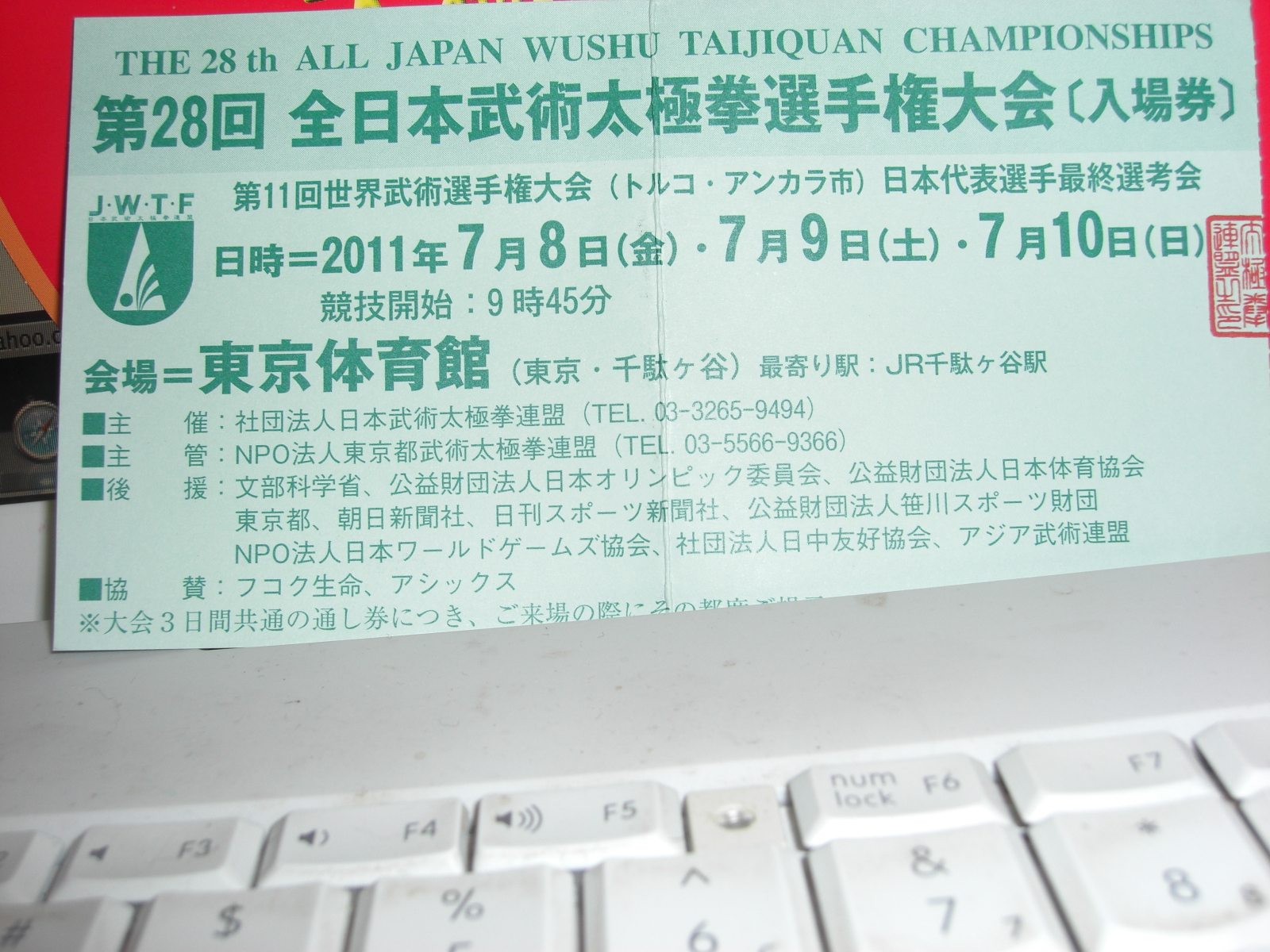
Every summer in Tokyo we can see the all-Japan tournament, combining tai ji quan and wushu/ bujutsu/ other martial arts. It is really an extraordinary event, overwhelming because there is just too much going on, with action in six courts running almost non-stop for three days.

Due to work or practice commitments, I usually go for just part of each of the three days. I spent far more time there this year than usual, mostly because my daughter wanter to meet her gong fu friend. They didn't watch any of the action on the main floor - DS and other games were more important.

Fine for me, plenty to see below and many good friends to talk to. A quick search at youtube you bring some highlights for those interested.

Thursday, June 30, 2011

kung fu fightin'


I love this picture, something my daughter drew some months back, a couple people in gong fu uniforms.

We are still going to gong fu practice together, but since the earthquake in March, our practice time has been limited since many public buildings are closed at night to save energy. Still, we had an excellent class with our teachers last Sunday morning. It was kind of a breakthrough for my daughter. The first two hours were 自主トレ or self-practice, meaning that you are completely on your own to review by yourself, no help from the teacher. For the third hour, we had a lesson with one of the teachers (chang quan or long fist) and it was quite good. My daughter had her long-awaited introduction to the double bladed sword or jian.

More importantly, she worked hard for the first two hours. She loves her teacher and has no passion for self-practice. We tried a couple times at various locales, but being 8 years old, she was not interested unless the teacher was leading the class. So this past Sunday was great. Of course I had to guide her a bit and we did some drills together, but mostly she worked on her own, a big step forward.

Seeing her practice reminds me of my time spent teaching a childrens' karate class many years back. Not sure if she will continue gong fu in the US or not, or whether I will teach kids once back in the US, but it makes me think a lot.

Thursday, June 23, 2011

kuden -- oral transmission


What is kuden, the oral transmission? It represents an extra bit of teaching, something not given to everyone. It figures highly in iaido, though it is no longer so secretive as in the past. You can even find a book which collects many kuden teachings, now available for anyone to read. And it is even translated into English.

We sometimes practice variations in the established technique called kae-waza 変え技 in iaido. To me it is a great chance to explore and add options to the regular syllabus. Simple as the changes / additions are, many of the students cannot seem to grasp them and we endlessly review the same stuff. Hence group practice is slow, not advancing much at all.

Once in a while I can catch my teacher whipping out a slight variation on a higher level okuden 奥伝 form. Of course I will copy it on the spot, glance to him for comment. The best I can get is the tiniest of occasional, grudging nods. More often, I am left wondering whether I should be copying it, doing it in front of others.

Once I asked him about one such variation. He had done it in front of many people but no one seemed to notice. I practiced it on the spot (and did not get a nod). I asked him about it and his reaction surprised me. That’s not kae-waza! That’s kuden 口伝! (oral transmission, usually somewhat secretive)

I think I had made a mistake of asking too directly (and in front of other people), and had unintentionally put him on the spot. Hence his reticence / anger.

In the Chinese arts the same feeling comes up, though it may be more about haphazard transmission than guarding secrets (though that secrecy would have been much more important and guarded in the past).

Working on my notes for the Chen Style sword (jian) form, I realized I had encountered the same thing, just without the terminology of Japanese style koryu bujutsu.

I was running through the Chen taiji jian sword form. My teacher walked over and said “Haven’t I ever shown you this?” Then he proceeded to demonstrate a crazy new variation which I have never seen him show anywhere in the past ten years.

That was it. I have never seen it from him again. I make a point of adding that motion whenever I practice. When I have the chance, I try it out in front of him, seeking encouragement or at least reaction.

No nods of approval yet. But neither any smacks on the back of the head. Yet.

(notes for a better and more well-organized piece to come in the future)

Thursday, June 2, 2011

pure and correct transmission


I met Mr. Wu in 1999. I had been living and training at Ping Yang Wu Shu School in Zhejiang Province, China. I suddenly relocated to the larger city of Wenzhou and was introduced to Mr. Wu forthwith.

We began practicing tai ji immediately, meeting early every morning atop various buildings and in a few parking lots. He taught me the 42-motion competition form which I had started at the Ping Yang Wu Shu School. It was basically an English language and Chinese tai ji exchange and most of the lessons were one-on-one. We made occasional visits to the masters in the park for advice, but otherwise it was just he and I, morning after sleepy morning.

After my short year in China, I made a few trips back to Wenzhou, trying to balance my time between my many friends there, my former kendo students, and Mr. Wu. Each visit, we ran through the 42 form and he noted my progress as well as places for further improvement.

We keep in touch by email and his messages are often sources of inspiration for me. I will paraphrase one recent message below and may take great liberties in giving certain points more emphasis than they received in the original.

“It is your long-term goal to transmit Chinese taiji directly in America. Moreover, it is your goal to transmit it purely, exactly as you learned it, without changing or adapting it in any way.

This is an admirable goal. But to be honest, if your aim is to transfer it directly, purely, exactly as you learned it, without any changes or modifications, it may be impossible.

According to the scientific view, a message is always attenuated during transfer / transmission. This change or reduction in the message is inevitable.

I used to see some Italians and Portuguese teaching Chinese Gongfu in Europe, in a very different format or a strange format. But people enjoyed it. That is enough.

And anyway, Chinese Gongfu is developing, even in China. It will die if it does not change and develop.

In short, you work harder at Chinese Gongfu than most Chinese people. You should make a great contribution to the future of Chinese Gongfu.”

Fairly heavy burden, but that is not our topic at the moment. Given that I will be relocating to the US within a year, I have much to think about. And much to practice and polish in these final days in Japan with my teacher here.

My first several years in Japan, I was extremely focused on Japanese martial arts and planned to take them back to the Midwest in the US. I have never thought of anything but pure and exact transmission, however much that may limit my commercial opportunities and the like. I have always seen myself as a cultural preservationist.

I learned it well. You come to my school, you do it my way. Changing or adapting the arts or the teaching style to the culture is not to be considered. (Am I getting old and stodgy or what?) (Yeah yeah I know, go read Dave Lowry’s book)

Ten years back, I met Mr. T, who has been my primary teacher ever since, and so began my drift into a heavy focus on Chinese martial arts. Though I now envision teaching mostly Chinese arts in the US, my stance remains the same: pure and correct transmission.

Then comes this message from Mr. Wu, throwing everything out the window…..