Monday, July 18, 2011

All-Japan tournament


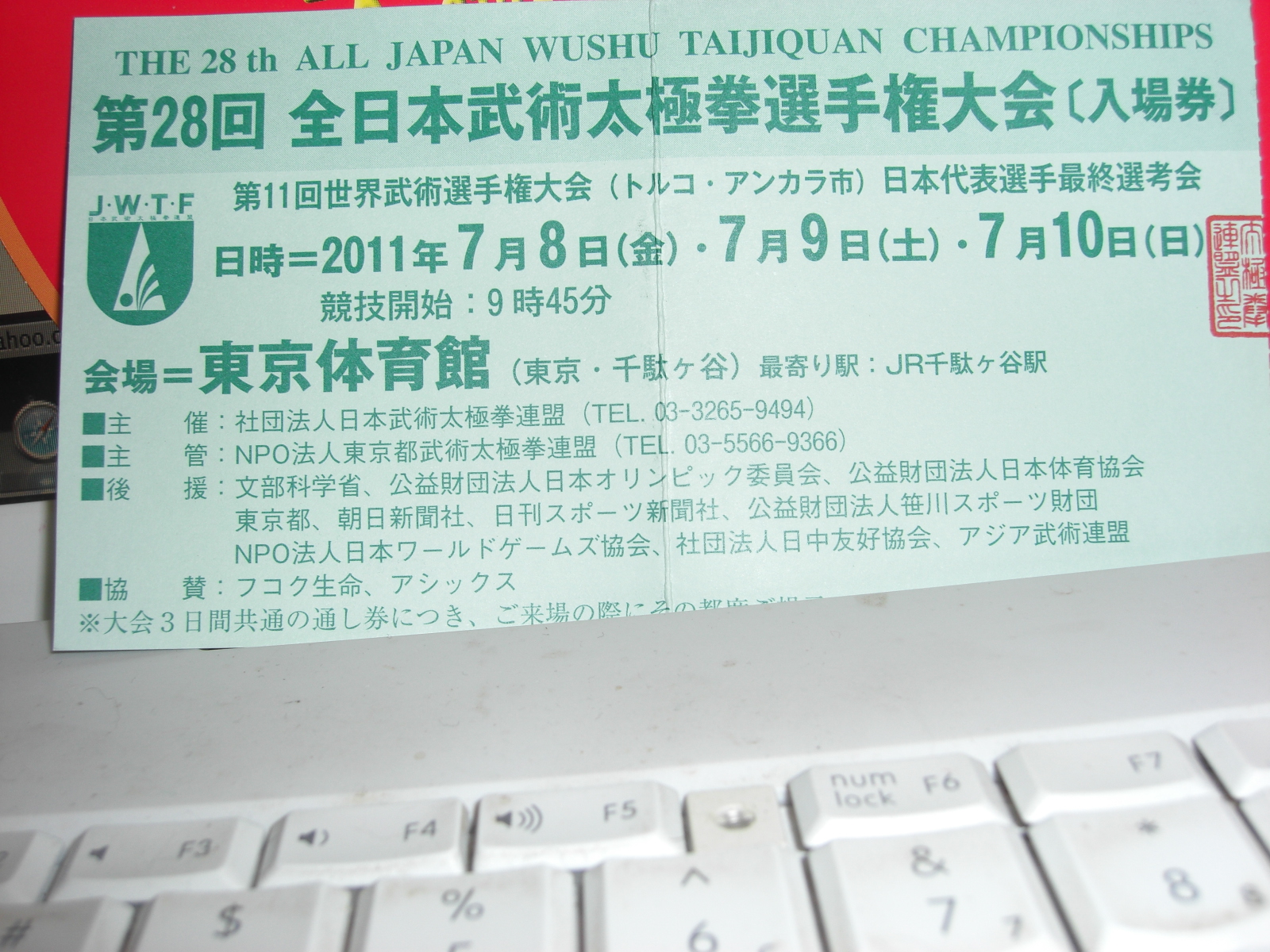
Every summer in Tokyo we can see the all-Japan tournament, combining tai ji quan and wushu/ bujutsu/ other martial arts. It is really an extraordinary event, overwhelming because there is just too much going on, with action in six courts running almost non-stop for three days.

Due to work or practice commitments, I usually go for just part of each of the three days. I spent far more time there this year than usual, mostly because my daughter wanter to meet her gong fu friend. They didn't watch any of the action on the main floor - DS and other games were more important.

Fine for me, plenty to see below and many good friends to talk to. A quick search at youtube you bring some highlights for those interested.

Thursday, June 30, 2011

kung fu fightin'


I love this picture, something my daughter drew some months back, a couple people in gong fu uniforms.

We are still going to gong fu practice together, but since the earthquake in March, our practice time has been limited since many public buildings are closed at night to save energy. Still, we had an excellent class with our teachers last Sunday morning. It was kind of a breakthrough for my daughter. The first two hours were 自主トレ or self-practice, meaning that you are completely on your own to review by yourself, no help from the teacher. For the third hour, we had a lesson with one of the teachers (chang quan or long fist) and it was quite good. My daughter had her long-awaited introduction to the double bladed sword or jian.

More importantly, she worked hard for the first two hours. She loves her teacher and has no passion for self-practice. We tried a couple times at various locales, but being 8 years old, she was not interested unless the teacher was leading the class. So this past Sunday was great. Of course I had to guide her a bit and we did some drills together, but mostly she worked on her own, a big step forward.

Seeing her practice reminds me of my time spent teaching a childrens' karate class many years back. Not sure if she will continue gong fu in the US or not, or whether I will teach kids once back in the US, but it makes me think a lot.

Thursday, June 23, 2011

kuden -- oral transmission


What is kuden, the oral transmission? It represents an extra bit of teaching, something not given to everyone. It figures highly in iaido, though it is no longer so secretive as in the past. You can even find a book which collects many kuden teachings, now available for anyone to read. And it is even translated into English.

We sometimes practice variations in the established technique called kae-waza 変え技 in iaido. To me it is a great chance to explore and add options to the regular syllabus. Simple as the changes / additions are, many of the students cannot seem to grasp them and we endlessly review the same stuff. Hence group practice is slow, not advancing much at all.

Once in a while I can catch my teacher whipping out a slight variation on a higher level okuden 奥伝 form. Of course I will copy it on the spot, glance to him for comment. The best I can get is the tiniest of occasional, grudging nods. More often, I am left wondering whether I should be copying it, doing it in front of others.

Once I asked him about one such variation. He had done it in front of many people but no one seemed to notice. I practiced it on the spot (and did not get a nod). I asked him about it and his reaction surprised me. That’s not kae-waza! That’s kuden 口伝! (oral transmission, usually somewhat secretive)

I think I had made a mistake of asking too directly (and in front of other people), and had unintentionally put him on the spot. Hence his reticence / anger.

In the Chinese arts the same feeling comes up, though it may be more about haphazard transmission than guarding secrets (though that secrecy would have been much more important and guarded in the past).

Working on my notes for the Chen Style sword (jian) form, I realized I had encountered the same thing, just without the terminology of Japanese style koryu bujutsu.

I was running through the Chen taiji jian sword form. My teacher walked over and said “Haven’t I ever shown you this?” Then he proceeded to demonstrate a crazy new variation which I have never seen him show anywhere in the past ten years.

That was it. I have never seen it from him again. I make a point of adding that motion whenever I practice. When I have the chance, I try it out in front of him, seeking encouragement or at least reaction.

No nods of approval yet. But neither any smacks on the back of the head. Yet.

(notes for a better and more well-organized piece to come in the future)

Thursday, June 2, 2011

pure and correct transmission


I met Mr. Wu in 1999. I had been living and training at Ping Yang Wu Shu School in Zhejiang Province, China. I suddenly relocated to the larger city of Wenzhou and was introduced to Mr. Wu forthwith.

We began practicing tai ji immediately, meeting early every morning atop various buildings and in a few parking lots. He taught me the 42-motion competition form which I had started at the Ping Yang Wu Shu School. It was basically an English language and Chinese tai ji exchange and most of the lessons were one-on-one. We made occasional visits to the masters in the park for advice, but otherwise it was just he and I, morning after sleepy morning.

After my short year in China, I made a few trips back to Wenzhou, trying to balance my time between my many friends there, my former kendo students, and Mr. Wu. Each visit, we ran through the 42 form and he noted my progress as well as places for further improvement.

We keep in touch by email and his messages are often sources of inspiration for me. I will paraphrase one recent message below and may take great liberties in giving certain points more emphasis than they received in the original.

“It is your long-term goal to transmit Chinese taiji directly in America. Moreover, it is your goal to transmit it purely, exactly as you learned it, without changing or adapting it in any way.

This is an admirable goal. But to be honest, if your aim is to transfer it directly, purely, exactly as you learned it, without any changes or modifications, it may be impossible.

According to the scientific view, a message is always attenuated during transfer / transmission. This change or reduction in the message is inevitable.

I used to see some Italians and Portuguese teaching Chinese Gongfu in Europe, in a very different format or a strange format. But people enjoyed it. That is enough.

And anyway, Chinese Gongfu is developing, even in China. It will die if it does not change and develop.

In short, you work harder at Chinese Gongfu than most Chinese people. You should make a great contribution to the future of Chinese Gongfu.”

Fairly heavy burden, but that is not our topic at the moment. Given that I will be relocating to the US within a year, I have much to think about. And much to practice and polish in these final days in Japan with my teacher here.

My first several years in Japan, I was extremely focused on Japanese martial arts and planned to take them back to the Midwest in the US. I have never thought of anything but pure and exact transmission, however much that may limit my commercial opportunities and the like. I have always seen myself as a cultural preservationist.

I learned it well. You come to my school, you do it my way. Changing or adapting the arts or the teaching style to the culture is not to be considered. (Am I getting old and stodgy or what?) (Yeah yeah I know, go read Dave Lowry’s book)

Ten years back, I met Mr. T, who has been my primary teacher ever since, and so began my drift into a heavy focus on Chinese martial arts. Though I now envision teaching mostly Chinese arts in the US, my stance remains the same: pure and correct transmission.

Then comes this message from Mr. Wu, throwing everything out the window…..
Wednesday, May 25, 2011

Storm rolling in


Last weekend, I had a short time slot between other events in the late afternoon, my only chance for some outdoor practice. I could practice any of 57 forms that need work, but I opted for some Ryukyu Kobudo, since I have a test coming up soon.

The dark clouds of a storm were rolling in quickly and the smell of rain was in the air. Time only for a short stretch, then outdoors to get down to business. I focused on a form with the bo or staff, 佐久川の棍小, sakugawa no kon sho. got through several reps before the rain started, and a few more as the drops fell lightly, tentatively.

Many thanks to the weatherguy in the sky, as those few reps were what I needed most. Heavy rains after that, but I got in what I needed just in time.

I will swing a wooden bo staff about in light rain, but certainly not my metal weapons like the sai. Just a few more days before the test. Today was sunny and I had an hour open in the afternoon, just right. tomorrow looks good, then rain from tomorrow night until test time....

Monday, May 23, 2011

you shoulda seen the other guy


yeah, not a scratch on him. Total self-inflicted wound, 自爆.

We were working on bo vs. sai.

hmmmmm. test coming up for me, lots of pressure every practice, very good feeling.

But I smacked myself good.

teacher / friend T. said that until you injure yourself with a weapon, you don't really know the weapon. Well I have cleared the nunchaku (past post) and tonight cleared the sai. Which one is next?

I recovered well, switching into free-style and doing whatever worked to restrain the opponent, but still, the pictures are not pretty.

We ran through the full set of bo vs. sai and I mucked up a couple times but recovered well -- not the official form but I adjusted naturally, smacked the other guy in an unexpected but effective way. Still, tonight's performance would not pass the test.....So I was satisfied, I could adjust in different circumstances, still whack the guy, but I couldn't pull off the needed techniques to pass the test.....

Check back next week....

Sunday, May 1, 2011

more reps of smaller chunks


That’s the advice I dole out to language / communication students and trainees regularly.

If you want to work on listening comprehension in whatever language, you need to take a small bit, say 3-5 minutes or less, and repeat it several times. But most people don’t take this approach. They have an hour’s commute by train, so they listen to a one-hour CD in the target language. Or they watch a complete, two-hour movie, rather than targeting a few minutes of that movie for intensive drilling.

It is human nature, I suppose. After, movies are supposed to be fun. You put one in the machine, sit back and enjoy uninterrupted. None of this once-with-script, once-without-script stuff. No vocab review and preview.

Vocab works the same way – to really master new vocabulary, the best approach is to work through several repetitions of a small list of target words or phrases. But most people (myself included…) invest the same amount of time in going once through a longer list. Less effective / efficient, but again, human nature.

Same in martial arts. I am one of the people who tends to do reps of entire forms, even though I know it is better from a learning perspective to isolate a part of the form and do more reps.

I attend several classes with my main teacher most weeks. In a typical class, we might go through a form once or twice uninterrupted, then spend most of the class isolating small chunks for intensive scrutiny and repetition. That’s especially true with the more common competition forms like tai ji jian 32. But it might also reflect the generally lower experience level of most people in the 32-motion tai ji sword classes.

We also have a class that focuses on the tai ji sword sets of the Sha family. Sometimes we follow the pattern above. Other times, like last week, we get a surprise. We started with several reps through the 36-motion tai ji sword form. Then we ran through the two-person paired sword form – an unprecedented 11 times.

I was wondering about the very unusual class format. In part, it must be related to the generally higher level of experience (even so, many of The Venerable Tai Ji Ladies were not quite on top of the form, shall we say). But I think it may have been the instructor’s way of cementing the form, drilling it in deeply one final time before moving on to something else.

And indeed, it looks like we will be starting the long-awaited second two-person / paired tai ji sword form of the Sha family. More reports on this later as it develops.

This is so-called Golden Week in Japan, when a number of national holidays fall together closely in sequence. The lucky people are able to arrange their schedules for about ten consecutive days off work. Others among us will be working most of today, teaching Business Communication Skills (notice the capital letters? It’s a fancy way of saying Business English. Which is a fancy way of saying “teaching English”).

I’ll be working one-to-one with a guy (oops, a Salaryman) from Company K. I am sure I will give him my regular lecture on “More Reps of Smaller Chunks”. I’ll also be running through some of the Sha family tai ji sword forms this morning before work. I wonder which style I’ll follow…